One of the most important ways to support a child’s human development is by creating a conducive physical environment. Unfortunately, most educators and parents don’t have the opportunity to design their space from its origins. This would be the ultimate luxury! Generally, when we acquire the space, we have to use all of our creativity and ingenuity to create a space that is going to support and help the child’s natural development. Let’s look at individual elements of the physical environment:
Size
The size of the space is crucial for the development of the child. If the space is small, the child might feel restricted and hindered in their exploration. It will also make it hard to balance the amount of material you will be able to display at once in the space. On the other hand, if the environment is too big, it can be overwhelming for the child. They may even feel lost. The key element here will be to balance between the amount of materials and children being put in the space. Traditionally, the space provided for children is often too small because this is frequently dictated by the requirements of the government where they live. The ideal size a Montessori infant community should follow is 7 square meters (or 75 square feet) per child. Having space can be very helpful because children at this age are trying to refine and develop their movement, so you will often see them losing their balance, bending down, falling over, and bumping into almost everything. However, not everything has this big of a space to provide for their little ones, so being creative with the environment and furniture will help you optimize it. For example, high ceiling rooms can allow for another level to give children more floor space because a lot of them work on the floor. Generally, the furniture in a Montessori room is very low. This allows children to have easy access to their activities, so adding one extra shelf that is still low enough for the child to reach means you can have more materials in the environment. Ultimately, giving you more floor space.
Lighting
The next important element is natural light. Light gives a feeling of tranquility. Having big windows will allow children to see life happening around them by seeing a bird fly by, a car drive by or a person walk past. If artificial light needs to be used, try to use full spectrum light bulbs that provide the little ones all the gradients of light. If possible, try avoiding using fluorescent trip lights because this can interfere with the child’s concentration as sometimes they start flickering when they stop working.
ACOUSTICS
Having big windows is great, but if there are too many windows, the sound might be amplified in the room which can be really challenging. Generally, spaces for young children have very little carpeting and very little soft furnishing, so the sound bounces off the hard surfaces, especially in an environment where there is a lot of glass. If you feel this might be an issue you are facing, providing some acoustical insulation can be very helpful. You can use sound isolating tiles, curtains, and even plants to help absorb the sound.
TEMPERATURE
The temperature must be comfortable for the child. It must be conducive to their needs. If the air is stagnant and doesn’t refresh, it might allow bacteria and viruses to linger. Ventilation can be your best friend in this situation. You want the air to circulate preferably through open windows. Additionally, if you keep the environment so much warmer or cooler than the outdoor environment, it can be very difficult for the children’s immune systems to constantly have to adjust to two different temperatures. Some people live in cold countries where they have to control their heating, and others live in warm countries where they have to control their air conditioning. Therefore, having a thermostat in the space can be very useful when controlling the temperature.
“The objects surrounding the child should look solid and attractive to him, and the ‘house of the child’ should be lovely and pleasant in all it’s particulars; for beauty in the school invites activity and work, as adults know that domestic beauty nourishes domestic unity“
Maria Montessori, The Child and the Family
Furniture
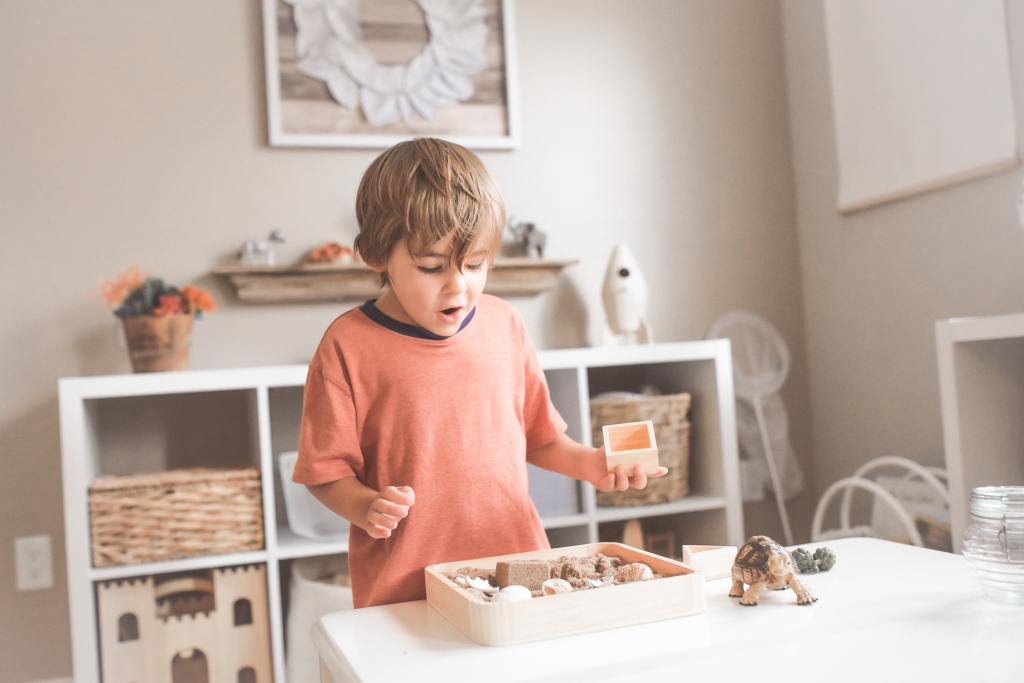
It has to be proportionate to the child’s height. This will help give the child the feeling that this space belongs to them. We want them to feel they are welcome in the space. It’s important that shelving is sturdy to avoid movement. Tables and chairs should not be too light or too heavy. They should be stable enough that if a child leans back, they don’t fall off of it. They should also be light enough, so that a child can carry it around. When the furniture in the environment is child size and easy to manipulate, it gives the child a feeling of comfort and belonging.
Materials
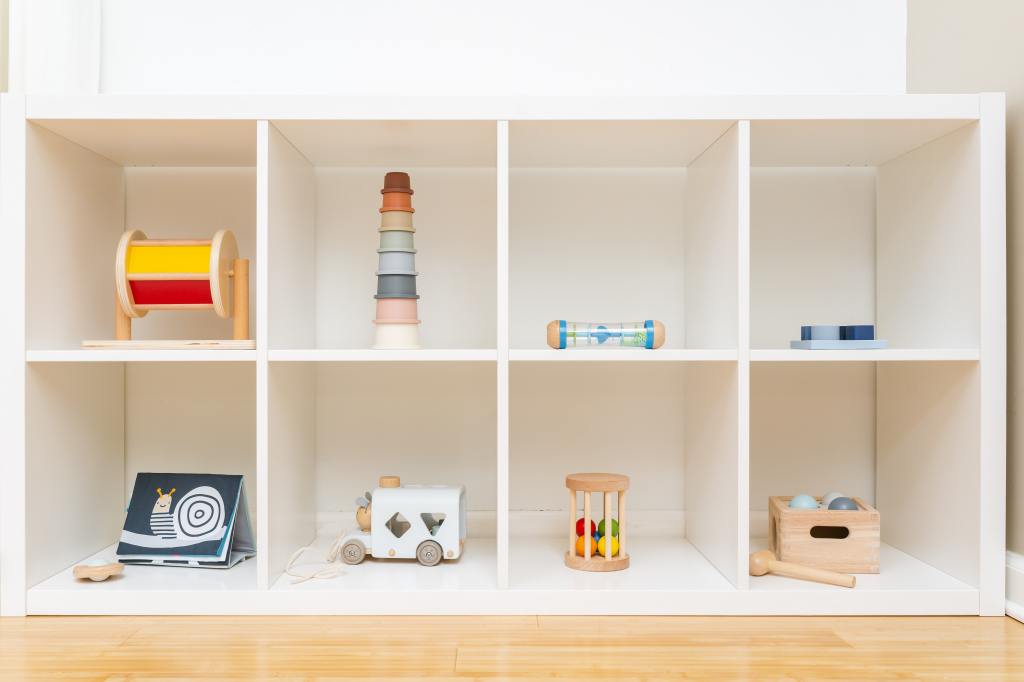
It’s important to remember you need a broad range of materials especially when you have more than one child in the space. You have to accommodate all children’s needs. Even if you have one child, the materials in the environment have to evolve with the needs of the child. Rotating materials will come in handy as you observe the child has successfully completed an activity and is no longer interested in it anymore. Everything in the environment must have an intelligent purpose. There must be a reason for placing each material in the environment. If there is an activity that has been collecting dust, you should remove it. It doesn’t need to be there if nobody is interested in it or working with it. We have to really look at their interests. Additionally, we should also look at properly storing these activities. You will often see in Montessori rooms the activities are stored and displayed in baskets and/or trays. Preferably, trays should have high edges and handles to make it easier for children to successfully carry their activities. Correct handling and modeling of carrying trays is very important. Adults have a tendency to carry things with their fingers, so the child’s absorbent mind will be tempted to do the same.
Because children have a very strong sense of order, all materials should be grouped in a logical order. Therefore, you should have all the manipulatives together, all the language activities together, all the food preparation together, all the practical life materials together, and so on. When a child sets an activity out, you should encourage them to place the activity back in the same spot. It will make it easy for them to remember where they need to go next time they want to work on that activity again.
You will also notice that Montessori spaces (in western cultures) display their materials from simple to complex, from left to right and top to bottom. However, if you are working in a NIDO environment where most kids are learning to crawl, you should place the easiest activities at the bottom. On the other hand, if those same kids are now learning to walk in an unbalanced manner, chances are they will fall down when trying to pick something up from the low shelf. Therefore, The environment should be changing and evolving with their needs.
Apart from observing the child interacting with the environment, you should also observe the materials’ condition. Repair or simply remove any material that is broken or chipped, or missing a piece. When you offer a child to read a book with a torn page or allow them to be in a room with a wall that has been scribbled all over, this will encourage the child to do those things.
Conclusion and Inspection
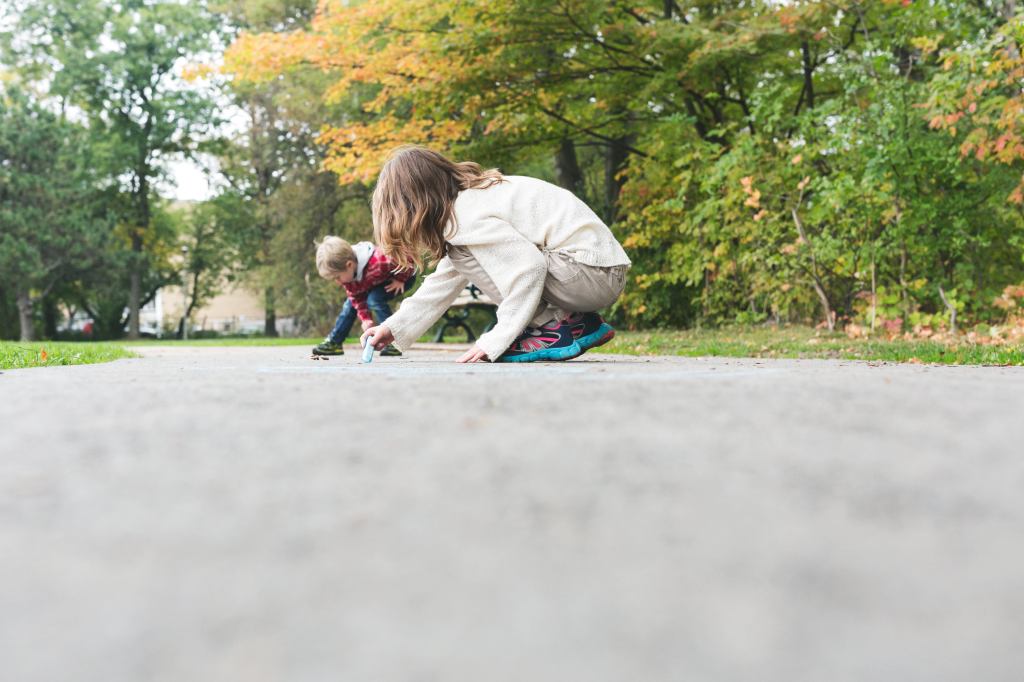
You should always observe and assess the environment to properly accommodate children’s needs. It’s our job to ignite the child’s interest by doing whatever we can to link the child to the environment. Lastly, when we are preparing the environment, whether it’s in the home or at school, you should conduct an inspection of the room by doing a walk through. If the child is not even crawling yet, you should lay on your back and observe what they are looking at. If the child is crawling, you should get down on the floor, crawl and see what they see. When you are preparing an infant space for a toddler, you should get down on your knees to be able to look at what they are looking at. The main goal is to look at the environment through their lenses!
 Braga Montessori